EN
EN

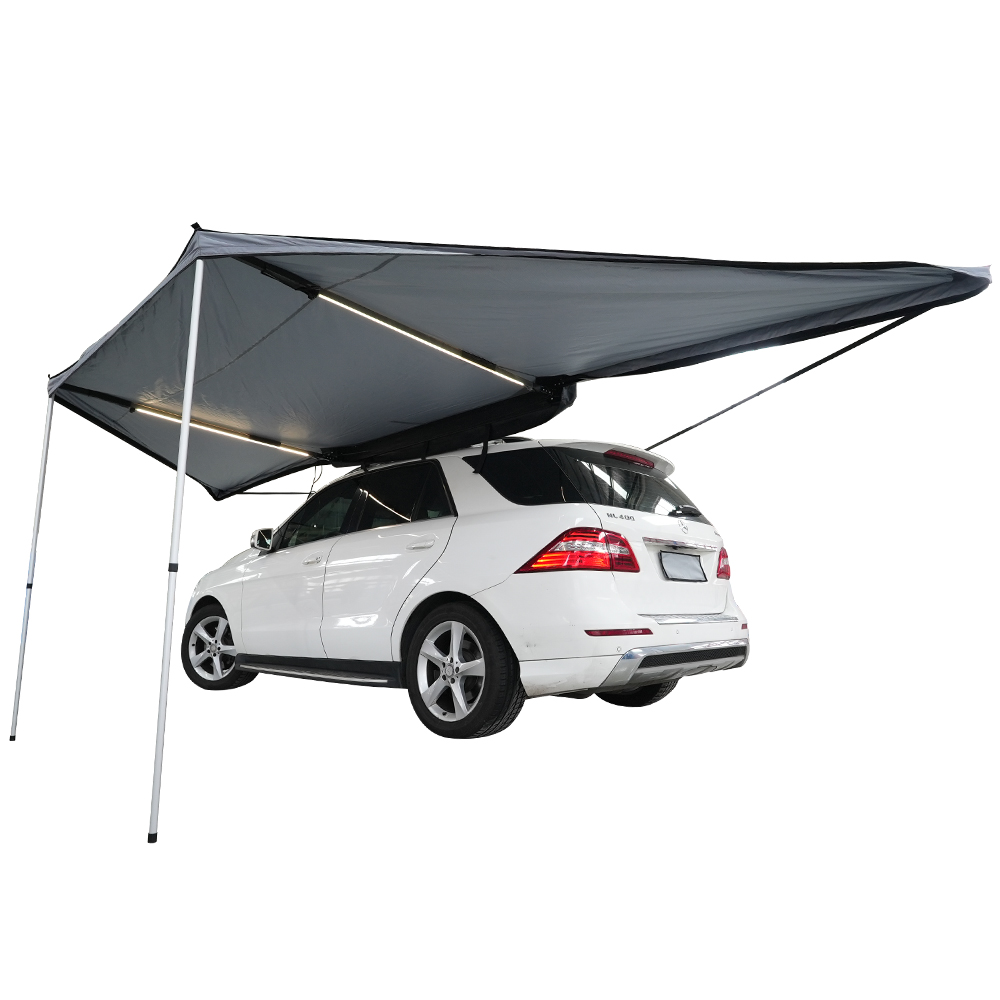
Understand Your Vehicle’s Physical Constraints for Car Awning Compatibility
Vehicle footprint, roof rail length, and awning extension alignment
Your vehicle’s physical dimensions determine whether—and how well—a car awning will mount and deploy. Begin by measuring the roof rail span: the distance between your front and rear crossbars. This measurement dictates where brackets can sit securely; a rail that’s too short forces mounting points inward, risking uneven load distribution or dangerous overhang beyond the vehicle’s footprint. The awning’s extension must align cleanly with your vehicle’s side profile—never obstructing door openings or rear hatch clearance. For instance, fitting a 2.5-meter awning on a compact SUV with only a 1.8-meter rail span creates forward projection that increases wind catch and reduces parking flexibility. Aim for full, gap-free coverage of your intended side while preserving an aerodynamic, balanced silhouette during travel.
Roof contour, cab height, overhang, and clearance for full deployment
Roof curvature and cab height significantly affect installation stability and shade utility. On curved roofs, adjustable brackets or spacers ensure the awning casing remains level—preventing fabric sag or abrasion against the body. Tall cabs (e.g., high-roof vans or crew-cab trucks) lift the awning higher off the ground, shrinking usable shaded area and often requiring longer support legs. Overhang—the horizontal reach beyond the vehicle’s side—must be evaluated against campsite obstacles like low-hanging branches or neighboring rigs. Crucially, full deployment clearance must account for rooftop accessories: cargo boxes, solar panels, or antenna mounts can interfere with unfolding fabric or leg extension. Always simulate deployment on level ground, confirming that legs fully contact the surface and the structure remains stable—even on slightly uneven terrain—to avoid premature wear or collapse.
Evaluate Mounting Systems and Structural Safety for Your Car Awning
Roof rack load capacity vs. awning weight and center-of-gravity dynamics
The roof rack’s dynamic load rating—not its static limit—is the true ceiling for safe awning use. While most car awnings weigh 13–20 kg, wind uplift during travel or gusts can multiply effective loading by 2–3×. Never exceed 70% of your rack’s rated dynamic capacity, especially since the awning’s center of gravity shifts dramatically outward when extended. This eccentric load risks crossbar bending, roof flex, or even vehicle destabilization at highway speeds. Build in a 30% safety margin for variable conditions, and prioritize weight distribution—centered mounting and reinforced brackets help maintain structural integrity and long-term roof health.
Mounting interface options: T-slot, U-bolt, clamp-on, and camper-integrated rails
T-slot channels on aerodynamic crossbars accept sliding nuts for a clean, low-profile fit. U-bolt brackets grip round or square bars tightly but require precise torque to avoid crushing tubing. Clamp-on adapters suit flat factory rails without drilling—ideal for temporary or rental setups—while camper-integrated rails (common on van conversions or truck campers) offer direct, drill-free attachment points that eliminate the need for a separate roof rack. Regardless of interface, always use stainless steel hardware to prevent corrosion, and follow manufacturer torque specs: overtightening compromises integrity, while under-torquing invites vibration-induced loosening. Match your system to your vehicle’s roof geometry—not the other way around.
Select the Right Car Awning Coverage Pattern for Your Camping Use Case
180°, 270°, and 360° configurations: door access, hatch clearance, and bed rail integration
Coverage pattern shapes real-world usability—not just aesthetics. A 180° awning extends along one side, delivering focused shade over side doors and creating a compact outdoor zone. It’s simple and lightweight but offers no rear hatch or opposite-side protection, limiting gear access from the back. A 270° awning wraps around the rear corner, covering both side and rear—enabling full lift-gate or tailgate operation and seamless integration with bed rails or rooftop tents. It’s the most versatile choice for vans, trucks, and camper conversions. The 360° configuration provides full perimeter coverage but demands careful planning: doors, hatches, and slide-outs must all remain unobstructed during deployment. Prioritize patterns that match your typical camping workflow—not theoretical maximum coverage.
Match Car Awning Solutions to Your Vehicle Type: SUV, Truck, Van, or Camper
Selecting the right car awning starts with recognizing how your vehicle’s architecture defines compatibility, mounting options, and functional limits.
SUVs typically offer the most straightforward integration thanks to standard roof rails or crossbars. A lightweight 180° or compact retractable awning mounted to the roof rack delivers fast, reliable shade without interfering with hatchback doors. Most mid-size SUVs support dynamic roof loads of 75–100 kg—ample for common 2–3 m awning models. Off-road drivers should favor low-profile, retractable units to minimize wind resistance and protect fabric from debris.
Trucks unlock unique configurations via bed rails and utility racks. A 270° free-standing awning anchored to a bed rack wraps around the tailgate, creating ideal coverage for tailgating, gear staging, or connecting to a truck-top tent. Hard-sided campers often feature integrated T-slot rails along the shell, enabling secure, drill-free mounting—just confirm bracket compatibility with rail channel width and verify combined rack-plus-awning weight stays within the truck’s payload rating.
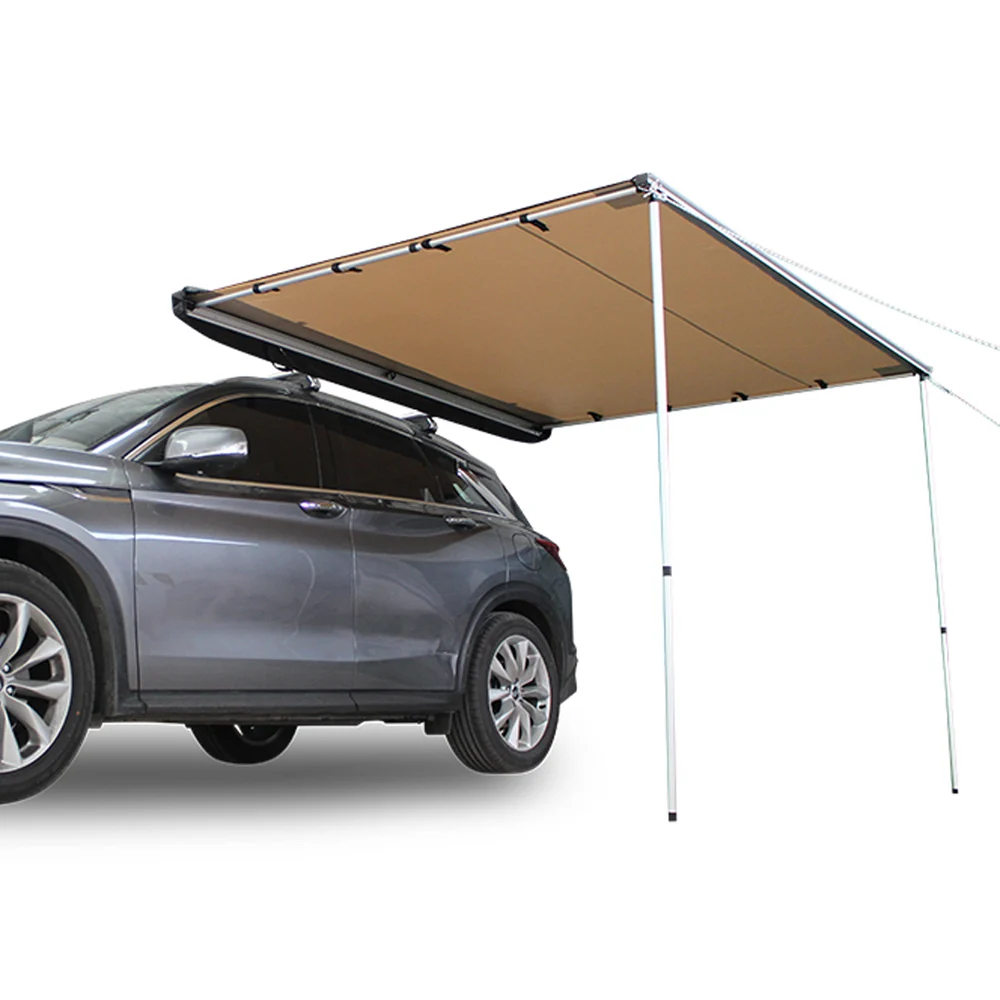
Vans and campervans require special attention to vertical clearance and roof height. High-roof models like the Mercedes Sprinter or Ford Transit need awnings with extended legs or wall-mount adapters to reach ground level; low-roof minivans may benefit from drop-down brackets to avoid door interference. Many modern campervan builds include pre-installed side-mounted awning rails—making 180° or 270° setups truly plug-and-play. For vans without rails, clamp-on or suction mounts offer non-invasive alternatives, though they trade off some wind resistance and deployment angle precision.
| Vehicle Type | Typical Awning Mounting Location | Recommended Awning Style | Crucial Considerations |
|---|---|---|---|
| SUV | Roof rack or crossbars | 180° or compact retractable | Roof load capacity; hatchback clearance |
| Truck | Bed rack, utility rack, or camper shell rails | 270° or free-standing | Bed rail alignment; overall payload rating |
| Van | Side-mounted awning rail, clamp-on brackets | 180° or 270° with adjustable legs | Roof height; door and window clearance |
| Camper | Integrated awning rail or roof rack | 270° or 360° wraparound | Compatibility with slide-outs; wind load ratings |
Regardless of vehicle type, match mounting hardware precisely to your rail or rack system: universal U-bolt kits work for round or square bars, while T-slot bolts are mandatory for aerodynamic rails. Also calibrate extension length to footprint—e.g., a full-size SUV often needs a 2.5 m awning for full side coverage, whereas a compact truck may only require 2 m. Always test full deployment in a safe, open area before departure to verify clearance with roof hatches, liftgates, and nearby obstacles.
Frequently Asked Questions
What factors should I consider before purchasing a car awning?
You should consider your vehicle’s dimensions, roof rail length, cab height, and roof structure to determine compatibility. Additionally, evaluate the type of mount, coverage pattern, and your typical camping use case.
What is the difference between 180°, 270°, and 360° awning configurations?
A 180° awning provides shade on one side, while a 270° awning extends around the rear for side and back coverage. A 360° awning offers full perimeter coverage but requires careful planning to avoid obstruction of doors and hatches.
Can a car awning be mounted on any vehicle?
A car awning is vehicle-specific and should align with the roof architecture, rail, or mounting system of your vehicle. Different vehicles like SUVs, trucks, and vans may require distinct configurations and mounting techniques.
How do I calculate the weight capacity for a car awning?
Check your roof rack’s dynamic load rating and ensure the awning’s weight—factoring in wind forces—does not exceed 70% of this limit. Always incorporate at least a 30% safety margin for additional stability.
What is the best way to ensure my awning is safe to use?
Perform a full deployment test on level ground to check for clearance with doors, roof accessories, and other structures. Ensure the awning’s support legs are stable even on slightly uneven surfaces, and follow the manufacturer’s torque specifications for mounting hardware.
Table of Contents
- Understand Your Vehicle’s Physical Constraints for Car Awning Compatibility
- Evaluate Mounting Systems and Structural Safety for Your Car Awning
- Select the Right Car Awning Coverage Pattern for Your Camping Use Case
- Match Car Awning Solutions to Your Vehicle Type: SUV, Truck, Van, or Camper
- Frequently Asked Questions